
AI-Enabled Design
I design AI-enabled workflows to help people connect the dots. AI should surface patterns, relationships, and implications buried in complex data, but never replace human judgment. My work focuses on using AI to create clarity, support confident decisions, and keep people in control.
Examples
The following examples highlight my approach to designing AI-enabled workflows. Each focuses on helping users connect the dots, make informed decisions, and act with confidence within real-world systems. Click on them to view them larger.
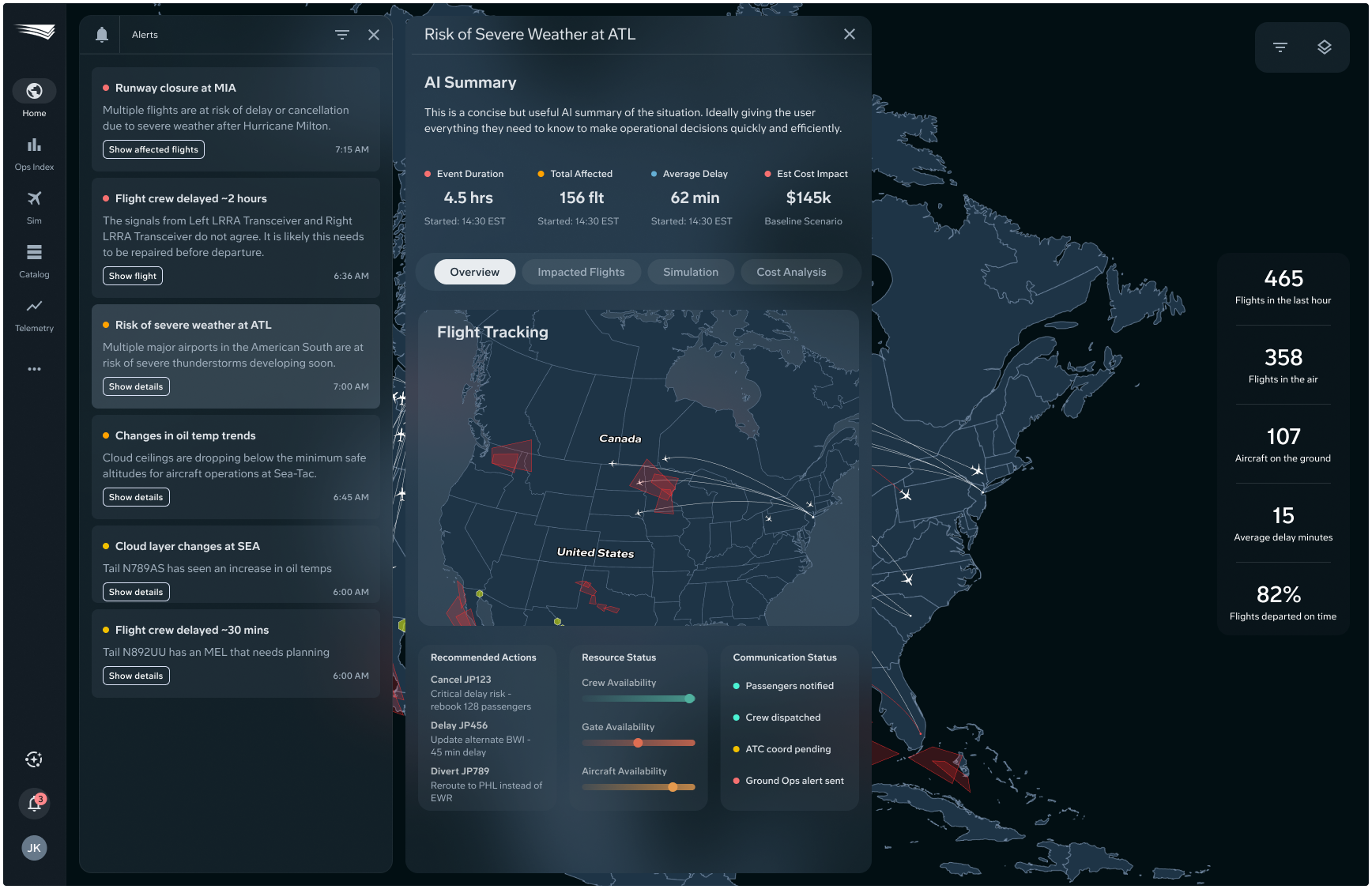
A digital twin, powered by agentic AI and complex datasets
This digital twin helps airline operations teams understand the downstream impact of disruptions by connecting data across systems. Real-time alerts, geospatial flight data, and operational metrics are synthesized by AI to surface patterns, tradeoffs, and recommended actions across flights, resources, and costs. Teams can explore affected flights, run scenarios, and evaluate options under time pressure.
A smarter chatbot for modern airlines
This AI-enabled interface pairs a real-time operational map with a conversational assistant that lets teams explore conditions using natural language. The assistant, among other things, acts as a control layer for filtering airspace, assessing disruption risk, and triggering simulations, while the map maintains continuous spatial context for faster operational decisions.
AI beyond chatbots: an autonomous aircraft
This interface supports AI-enabled autonomous drone operations across the full mission lifecycle, from planning and routing to monitoring and intervention. It brings together mission planning, real-time vehicle state, regulatory constraints, and contextual maps so operators can validate routes, alternates, and edge cases while maintaining clear human oversight in a safety-critical system.
Another look at the chatbot
This conversational AI interface gives users a direct way to query domain-specific information and operational status. It supports natural language questions, structured responses, and persistent context so users can retrieve explanations, updates, and reference data without breaking their workflow. The focus is on predictable behavior, clarity, and trust in everyday AI-assisted work.